Tuesday, May 17, 2011

Tips for parents of kids with disabilities

Marcus unloads the silverware from the dishwasher, learning responsibility at an early age.


I wrote this essay on Helium.com several years ago and wanted to share it here on my blog.

As an adoptive parent to several children with disabilities and as a pediatric occupational therapist, I would like to offer some tips to parents of children with disabilities. They are gleaned from my own successes and mistakes, as well as the various parenting styles I have observed in my work.
1. Don't be afraid of labels. No parent likes to have their child labeled, whether it is as the class clown, a troublemaker, autistic, or mentally retarded. One of my children suffered a severe traumatic brain injury as the result of abuse at an early age. Even as his cognitive deficits became more apparent over time, I insisted that the schools put a "Traumatic Brain Injury" special education code on him, not a "mentally retarded" code. When he graduated from the public schools, I came to regret that decision. As an adult, there are virtually no services for a brain injured person, while there is a vast array of programs and services for the mentally retarded/developmentally delayed. You know your child is much more than a label, but try to accept the label as a ticket to better services for your child.
2. Be skeptical of miracle "cures." Having been in this professional field for almost 30 years, I have seen many miracle cures come and go. There was patterning, neural pacemakers, rhizotomy, etc. Some people exhausted their financial resources or sacrificed their family life for what turned out to be false promises.
3. Walk the fine line between making your child feel special and making him self-centered. One of my children has severe cerebral palsy, but normal intelligence. I quickly saw that most folks assumed she was mentally delayed and they tended to ignore her or talk to her as if she were a baby. So I went out of my way to include her in social situations, brag about her accomplishments, and, in short, make her the center of attention. My strategy backfired, in that she became self-absorbed, always expecting to be the center of attention. Yes, your child is special, but no more special than every other child.
4. Let your child be a child. You may feel that, with all the therapy, medical appointments, and educational needs your child has, you have to make every minute count. But your child has other needs: to play, to develop his own interests, make friends, be goofy, daydream.
5. Encourage your child to become independent. It is often easier, quicker, or less messy to do things for your child, but you won't be around forever. Let your child develop that sense of accomplishment and competence that we all need. And if your child does need help, teach him to ask for it in a gracious way.
6. Fight for your child's rights, but teach him responsibility at the same time. If you insist that the school buy your child an expensive notebook computer to do his school and homework on, it is important that he understand that he has to take care of it and that you do expect him to complete his assignments.
7. Help your child deal with uncomfortable social situations in a positive way. Fortunately, this is a much easier task than it was 20 or so years ago when I began rearing my children. Thanks to the push for mainstreaming, most children today have had some experience in being around and relating to peers with disabilities. But your child may still encounter stares or remarks in public. Maybe it makes you mad or uncomfortable, but try to remind yourself that usually the person who is staring intends no harm, but is only curious. Often just smiling and saying hello diffuses the situation. I often think of the time I was at Six Flags with my son who had Tourette's syndrome, with many facial tics. We were in the line for a ride, and kept passing the same kid each time the line snaked through the aisles. The other kid kept staring and staring. I began to feel anxious and tried to stand between the kid and my son, so as to block his view. Finally my son leaned over to whisper in my ear, "See that boy over there? He's got an eye problem...he keeps staring!" What insight...my son was able to see the situation as the boy's problem, not his!
8. And lastly, take care of yourself! Everyone has a bad day...forgive yourself for your impatience, grief, or mistakes. Try to get your rest, find support, make friends, pursue your own interests. Don't let yourself get so drained that you have nothing to offer your child.
I hope these tips will be helpful. I like to remind myself that there are lots of different styles of parenting, but most parents are doing their best for their children.

Friday, May 13, 2011

Daring to hope


Gabriel had an appointment with the psychiatrist today.  He remarked on how much quicker we got in and out, compared with our appointments at MHMR in Texas.  That made me think of the many differences in the services he gets here in St. Louis, compared with those in Texas.

At Texas MHMR, we usually spent 3-4 hours, to get his blood work, meet with a case manager who did nothing but mechanically fill out the required paperwork, and see the doctor for 5 or 10 minutes.  When Gabriel entered that doctor's office, she almost always turned on a fan so she wouldn't have to smell him, and she often took personal phone calls while she met with us.  I had begun reading about the Clubhouse movement, which is a worldwide movement with mental health clubhouses in 30+ countries from Japan to Israel to Poland to South Africa to Kosovo, but whenever I mentioned the need for a clubhouse to the staff at MHMR, not a single one of them had ever even heard of a clubhouse.  Getting his prescriptions, one of which is very strictly controlled, often required 3 trips to a pharmacy downtown, including a wait of an hour.

Here in St. Louis, mental health services are provided by Barnes Jewish Behavioral Health.  Today Gabriel got his blood work, met with the psychiatrist for 30 minutues, worked with his case manager for another 30 minutes, and turned in his prescription at the on-site pharmacy (we'll receive the medication in the mail on Tuesday), and we were in and out in an hour and fifteen minutes.  The nurse who does the blood work knows Gabriel by name on sight.  The doctor actually talks to him, asking probing questions about his symptoms, his activities, his goals.  She tries to educate him about schizophrenia and related health issues.  Gabriel told her today that he thinks he's doing better, because he only thinks about the Russian mob trying to kill him once every hour, rather than every five minutes.  He was able to explain that his hallucinations seem real, like dreams, when they're happening, but he can understand that they're not real.  Then he worked with his case manager on practical skills, like keeping a log of his blood sugar readings.

As we left, rather than feeling defeated and hopeless, as I often did when we left MHMR, I dared to feel hopeful, dared to feel that Gabriel isn't just spinning his wheels any more.

Wednesday, May 11, 2011

Help Nisha change the world!


One of the joys of following other people's blogs is that, in reading the comments readers leave, you can meet even more wonderful, interesting, inspiring people.  Last night I was reading "Love that Max," and I saw a comment by a young woman named Nisha, who lives in South Africa.  She said she had cerebral palsy, as does Max, and that  "in the interest of being helpful I would like to ask that you NEVER LOWER YOUR EXPECTATIONS for Max."  I was intrigued, and followed the link to her blog, The Adventures of Me.


Immediately I liked Nisha's sense of humor:  the subtitle of her blog is,  "If God is watching, I plan on being entertaining."  As I read further, I found that this is an extraordinary 20-year-old.  Yes, like most of her peers, she likes to listen to music, watch movies, talk with her friends, spend time on the internet and Twitter.  But, unlike many of her peers, she is determined to change the world.  At the age of 20, she has discovered on her own what many people never learn in a lifetime:  "I am at my happiest when I give of myself in whatever way I can at any given moment in time."


So Nisha has decided that one way she will make the world a better place is to raise money and awareness for one of the world's most urgent causes:  access to clean water.  She has set a goal to raise $6500 for The Water Project and to build a well in a community that lacks clean water.  So far, she is 57% of the way to her goal.


I want to urge all my readers and friends to contribute whatever you can to Nisha's cause.  You can donate through her First Giving page.  I encourage you to visit her blog and read a few posts...you will be inspired and blessed by this young woman's writing and generous spirit!  

Monday, May 09, 2011

Down home on the ranch


Since my boys are now all adults with developmental or mental health disabilities, I am of course concerned about where they will wind up when I'm gone.  I've done quite a bit of research online, looking for high quality, innovative programs for adults.  Tevis was in a group home for many years, because of his need for constant supervision and because of his explosive behavior, so I've seen the "average" group home, and I was not impressed.  The first group home was an ICFMR facility with 6 residents; the second was a Medicaid waiver home with 3-4 residents.  The second was of better quality, with better administration, but both were plagued above all by the quality of direct care staff.  Given the low pay and the sometimes stressful work, turnover was a constant problem and the administrators obviously had to take what they could get.

I have long admired the L'Arche movement, a worldwide movement founded by Jean Vanier in France in 1964. He had a vision of homes where people with and without disabilities lived together in an intentional community, sharing their faith and their daily lives.  Similarly, the Camphill movement, based on the writings of Rudolf Steiner, has established communities where people with developmental disabilities live and work with non-disabled "coworkers," many in rural settings where they also promote sustainable agriculture.  Unfortunately many of these programs charge a hefty tuition or residential fee, putting them out of the reach of most persons with disabilities and their families.

A few residential programs which have been influenced by the ideas of Vanier and Steiner do accept public funding (Medicaid), however.  One of these is Down Home Ranch in Elgin, Texas.  Founded by Jerry and Judy Horton in the early 1990s, it is a working ranch where 20 ranchers with Down syndrome and other developmental disabilities and live-in resident assistants live and work together.  Along with caring for livestock, the ranchers cultivate hanging baskets, Easter lilies, and poinsettias in their five greenhouses to sell to the public.  During the summer, 500 campers enjoy a week of Ranch Camp at the ranch.  It sounds like a great residential option, and I'm hoping to check it out, perhaps sending Tevis down there for a camp session this summer.

Saturday, May 07, 2011

Mothers and other strong women


This is one of my favorite photos, featuring, from left to right, my mother, my grandmother, and my aunt.  My aunt used to refer to this portrait as "The Three Goons," probably because it was pre-nosejob for her.  But I love it.  These are the strong women in my life who taught me by example to persevere, to be fair, to work hard, to help others, to be independent.

My grandmother, affectionately known to friends and family as Anna B, raised these two daughters virtually as a single parent.  My grandfather returned from the battlefields of WWI as a shell-shocked medic (the archaic term for PTSD), and he was never the same.  Eventually he was committed to the psych ward at a VA hospital, where he lived the rest of his life.  My grandmother began teaching in a little two-room country school when she was just 17.  She didn't even have a high school diploma, but she went on to earn not only her diploma, but a BA and a Masters, all while working full-time as a teacher.  And I mean working!  She drove the dark country roads long before dawn to get to school early, so she could build a fire in the wood stove so the school room would be warm when her students arrived.  During the Depression, she gave the kids haircuts and ran a clothes closet out of the storeroom.  She got farmers in the area to donate a small part of their crops and created a veggie burger made out of blackeyed peas and ground pecans.  (The county extension agent did a survey of the nutritional status of students in the area, and the kids at my grandmother's school had the best nutrition out of all the schools.)  

Anna B with her class at Sally Brown School

My brother and I went to Muskogee OK to stay with her for a week every summer, and how well I remember those times.  We pulled into her driveway after the sun went down, and we rushed to the porch to ring the doorbell with the crescent moon glowing on it.  She would come to the door, making a sort of cooing sound of pleasure at our arrival, and give us a kiss and hug, enveloping us in the smell of face powder and Sweetheart soap.  We spent our week driving from house to house, visiting friends and family.  I explored the books on my grandmother's book shelves, and she always gave me a few out-of-adoption textbooks discarded by the school.  She had an old treadle sewing machine and I liked to give my dolls rides, up and down, on the treadle.  As hard as I tried, I couldn't follow the adult conversation about relatives I couldn't keep straight, so I amused myself.  (Now I wish I had absorbed all those family stories!) 


Aunt Jing


My Aunt Jing followed in her mother's footsteps and also became a teacher, then a principal.  She had no children, so she doted on us.  "Jing" came from my brother's childish attempt to say her name Jimmye.  She was christened Lillian Adelaide, but her father called her George.  Finally my grandmother told him to stop calling her that, to come up with something better, so he called her Jimmye.  It stuck and she had her name legally changed.  Evidently Aunt Jing was known as a tomboy when she was younger, but as an adult she was always dressed to the nines, with perfect hair and makeup.  She loved to talk, and when she came to visit, she and my mother would sit at the round dining table for hours, savoring their coffee and their conversation.  Aunt Jing loved to tell stories and was always quite precise in her pronunciation and in her choice of just the right word.  In the 90s she began to have some problems with her memory and was diagnosed with Alzheimers.  We were all devastated, especially my mother.  How she had enjoyed talking with her sister on the phone every Saturday; now the phone was silent.  What a cruel disease...it took everything from my dear aunt:  her intelligence, her language, her smile, her vivacious personality.

And then there was my mother.  She was born while her father was in France during WWI, and when he returned, shell-shocked, he was apparently unable to bond with his little daughter.  My mother never talked about her father until just before she passed away, saying "it was bad" before he was committed to the hospital.  I knew that my mother had gone to a boarding school as a teenager, but I never knew why she was sent there, while her sister stayed home.  Finally I learned that my grandmother sat my mother down when she was 12 and said,  "You know your father can't accept you.  It would be better for everyone if you went away to school."  WOW!  What a thing to tell a 12 year old child!  I think this is why my mother was content to be a stay-at-home mom, even though her mother and sister had worked.  She wanted to give us what she had missed out on as a child and teenager.  I think of all that my mother went through, both because of the time in which she grew up and started a family and because of her personal circumstances, and I am amazed at her strength and her ability to stay positive.  Over the years, she sometimes referred to "during the Depression" or "when I was at school" or "during World War Two," but I never really heard her dwell on the difficulties of those times.

My mother Esther Alice Adams Gregory

When I look back at all my mother did when I was growing up, I am humbled by how hard she worked.  She brought up three children, all of whom graduated with honors from high school and went on to graduate from Rice.  And those were the times when mothers used cloth diapers, hung their wash on the clothesline, ironed everything, cooked from scratch, washed dishes by hand.  My mother also sewed all my clothes and hers, made curtains, reupholstered the furniture.  In her spare time (yeah, right) she was room mother and Girl Scout leader and Sunday school teacher.  She had a heart attack when I was in junior high and had to quit some of those extracurricular activities, but she always worked hard, keeping the house and the family finances.

Mother and the kids 1955

In her later years, she developed macular degeneration and lost most of her vision.  It was a source of great frustration for her.  Hardly a single conversation ended without her having made some reference to "you know how my vision is" or "I can't read that because of how my vision is."  I wondered how she would get along after my dad passed away.  But she was one tough little lady.  She continued to live in her independent living apartment, with a little help from me to order her medication and take her to the grocery store.  She had a stroke, which caused severe aphasia.  In rehab, the PT told my brother that my mother would most likely have to go to a nursing home.  He didn't know my mother!  She was able to go back to her apartment with just a little extra help.

My mother on her 91st birthday

Those last three years after my dad died were a gift for me.  I was happy that I was able to help my mother, to return in some small measure all that she had done for me.  Spending more time together, especially after her stroke, we became closer than we had ever been.  When her final illness came, I regret that perhaps I made medical decisions that caused her unnecessary pain.  Images of her final days still haunt me.  But I am grateful that we were able to speak honestly, to tell each other how deep our love was, to say goodbye.  She spoke to me with her last breath, looking into my eyes.

So these are the Adams women, who helped to make me who I am.  I miss them so much and would give anything to sit with them one more time, around my mother's round table, sharing coffee and conversation and love.

Wednesday, May 04, 2011

The cloud of the future


Today Gabriel had an appointment with the nurse practitioner to recheck his diabetes medication and glucose levels.  The clinic is in the same location as his mental health provider, and, as we sat in the waiting room, his case manager came in.  She came over to Gabriel and began asking him if he brought his record of blood sugar levels, did he bring a list of his medications, etc.  She had to take care of another matter, but she told him she would be back.

I knew that she planned on going back with us when the nurse called him.  Unexpectedly, I felt a wave of resentment rising within me, and it took me by surprise.  After all, isn't this what we moved up here for:  to obtain the support services that Gabriel needs?  Why did I have this almost visceral response?  As I thought about it, a dark cloud seemed to skim across my mind.  In those few dark moments, I saw a future without me, Gabriel on his own against the world and his schizophrenia.  That vision was so vivid, so distressing, that I had an unsettled feeling during the rest of the appointment.

This is the worry, the sometimes anguished distress, that haunts parents of children with developmental disabilities or severe mental illness...what will happen to my son/daughter when I'm gone?  We search for programs and support services, we consider residential options, we draw up wills and set up trusts.  But, especially if our family is not a close-knit one, we fear that eventually our adult child will be "cared for" only by people who are paid to be there.

Let's face it, girls...


I was driving to Chicago a couple of weeks ago when I passed this road sign.  In this town the young folks have to watch out for people who are older and have more insurance.

Sunday, May 01, 2011

A quarter of a century


Yesterday was Gabriel's 25th birthday.  As usual, we just celebrated as a family, going to Chili's for supper and then having cake and presents at home.  Gabriel wanted a red velvet cake, which is sort of a family tradition dating back to Jesse's childhood.  My mother, understanding how hectic my life was as a single mom to so many kids (not to mention the sheer number of birthdays we celebrated!), started offering to buy a cake for the kids' birthdays.  Living close to the Red Oven Bakery in Arlington, she always bought the cakes there, and usually got their specialty:  red velvet cake.  But apparently red velvet cake is more of a Southern thing, and most bakeries here don't make it.  I finally decided to make it myself, and it turned out pretty darn good, if I do say so myself!

Of course, birthdays are always a time for a bit of reflection.  I have to say that this year Gabriel is doing pretty well.  At least he's doing better this year than he has since his 20th birthday.  It was 3 months after his 20th birthday that he had his first major psychotic break.  Since then birthdays have come and gone, and he has slept through them, been hospitalized with blood sugar at 850 on one, has generally been spinning his wheels as life passed him by.  But this year is different.  I can look back over the last year and see that he has made progress since his last birthday.  He goes to the Independence Center every day, where he is around other people, has work that he does, has a reason to get out of bed.  He has better medical care up here, and adjustments to his medication have lessened the intrusiveness of the voices.

So, Happy Birthday, Gabriel!  May you continue to build a meaningful life for yourself...

Friday, April 29, 2011

Artists at work


Finally winter's snowpack melted and we were able to venture forth from our house. Gaining access to state programs for the developmentally disabled has been extremely slow, and I have little hope that Marcus and Tevis will actually get any services. Apparently the only folks who actually get help are those whose parents have died and who have nowhere to go. So I set my mind to finding other community programs for the guys.

Fortunately, while searching on the internet, I found the Turner Center for the Arts. Located in the quaint old downtown area of Maplewood, with other studios and shops, the studio provides an open studio for artists with and without disabilities. Most of the artists are autistic or developmentally disabled. I knew this would be right up Tevis' alley, as he has always loved any type of art: drawing, painting, glueing, cutting, crafts. So initially I took only him. I admit that the first time he went, I breathed a great sigh of relief when I dropped him off. This was the first time I had had three hours to myself since we moved to St. Louis! Ahhhhhhh! And I only had to pay $10 for him to participate for three hours. He enjoyed the artwork immensely, so he began attending regularly twice a week.

I didn't really think Marcus would be interested. He used to draw quite a bit when he was young, but hadn't shown any interest in art since then. But he decided to give it a try, probably just to get away from the house after being housebound for so long during the severe winter. Surprisingly, he enjoyed himself and wanted to keep attending.

On a warm spring evening recently, the studio held an art show. The guys were proud of their displayed work. I was proud, too, and not only of the finished products. I was proud that Tevis has been able to go to a community activity without any behavioral issues. I'm proud that Marcus was able to get out of his rather rigid routine to try something new. And I really appreciate this center that gives folks with disabilities the opportunity to express and discover their creative talents.


Sunday, January 23, 2011

Marking time


I have to admit that I rarely have a moment when Gabriel's schizophrenia does not weigh on my mind. I suppose that's because, relatively speaking, its onset has been recent. I mean, I rarely think about my other kids' disabilities. Since they have been disabled from the day I first met them, indeed from the day I first heard about them, their cerebral palsy or spina bifida or dwarfism is just a given. Yes, occasionally I still think about what their lives would have been like if they hadn't had a disability, but I can set those thoughts aside. But with Gabriel's schizophrenia, it's different. I know that's because the disease has taken so much from him. The Gabriel I knew for 20 years---the impish, vivacious, charming child---is gone, and in his place is a moody, withdrawn stranger, without affect or motivation. Sometimes that stranger makes me uncomfortable, sometimes he gets on my nerves, sometimes I feel so sorry for him. And of course I feel guilty for feeling that way.

Most of the time the pain is a dull ache, but sometimes it pierces my heart. One of those piercing moments occurs almost every week. Most young adults mark time by referring to their age or what grade they were in when something happened. For example, "Boyz II Men was my favorite group when I was in 8th grade," or "Remember when I was 13 and we went to Padre Island?" But Gabriel marks time in a completely different way that breaks my heart. He'll say, "I remember that time we went to Burgers Lake, before the voices started."

Saturday, January 15, 2011

Hijacking MLK Day


I often cringe when I see businesses hijacking noble commemorations for commercial purposes. The historical achievements of George Washington and the lofty ideals of Abraham Lincoln are now marked only by "Presidents' Day Sales." Likewise, instead of remembering the fallen on Memorial Day or reflecting on the sacrifices of veterans on Veterans Day, most Americans observe those holidays by kicking off summer or by (once again) shopping Memorial Day Sales or Veterans Day Sales. (Veterans Day Sales? Really?)

So far, at least, the stores have not appropriated Martin Luther King Day for special sales promotions. But here in St. Louis, this day has been hijacked by something even worse. A local promoter has booked the "State of Emergency" tour for Monday, Martin Luther King Day. The concert features rappers Rick Ross, Wacka Flocka, Trina, and others. Ross is known for glorifying drug dealers. The lyrics of Wacka Flocka's "Oh, Let's Do It" glorify drugs, glocks, and money. (It's not known if Wacka will be able to make it, since he recently was arrested and charged with possession of marijuana, firearms--he’s a convicted felon--, hydrocodone, and violation of probation and the state’s “Criminal Street Gang and Terror Prevention Act.”) Trina, in the words of the promoter, "has continued to push the envelope of rap, with often-offensive, sexually explicit lyrics." The promoter claims that he is furthering the work of Dr. King, because in the time between sets, he and others will preach a message of non-violence. Uh-huh.

Dr. King is probably turning in his grave, or, more likely, wiping a tear from his eye.

Monday, January 10, 2011

Scapegoat

Ah, so now it begins: the scapegoating of all people with schizophrenia. This evening I had been to visit Gabriel on the locked psych ward where he has been for the last week. When I came back home, I checked the updates on Facebook and read the following comment:

"Simple soon as they sign up for SSI and claim a mental illness as the reason lock ' em up, restrain them, and medicate them thru shots or iv's. They wanna be state sucks let 'em live in a state hospital!"
I was spitting mad!

First, I thought of all that Gabriel has suffered during his 24 years. In the younger grades, he struggled in every area. Because of his OCD, he almost never turned in an assignment, because after he worked on it, it wasn't perfect, so he would wad it up and start over again...and again and again and again. Even in kindergarten he was acutely aware of his difficulties, and he would come home and ask me, "How come Matthew can spell hard words and I can't?" In primary grades he got invited to lots of parties, because it was the social custom to invite the whole class so no one's feelings would be hurt. In the upper elementary grades, that custom fell by the wayside and the invitations ended. He had Tourette Syndrome, with a number of facial and vocal tics, and that certainly didn't help him fit in. In middle school he was hospitalized twice, for a total of five months, with severe anorexia. When he was admitted the first time, he weighed 69 pounds and, in the words of the doctor, looked like he had been in a concentration camp. During the second hospitalization he was first diagnosed as psychotic. When he was 20, he had his first major psychotic episode, and was diagnosed with disorganized schizophrenia, the type with the worst prognosis. He spent 7 months in the state hospital. The disease robbed him of his cognitive skills, his social skills, and his vibrant personality. When he has a setback, the voices are unbearable, and once he said he thought about stabbing himself in the head to make them stop. And now here is a person who says he should be treated as an animal, locked away and restrained and drugged. Here is a person who sees him as nothing more than a parasite, a "state suck."

And then I was angry on a political level. This person, needless to say, is a right wing conservative. These are the people who castigate the mentally ill because they won't stay in treatment, but at the same time, refuse to adequately fund mental health services. These are the people who don't want "those people" on the streets, in view, but begrudge them the measly SSI payment that puts a roof over their heads. These are the people who don't want the government meddling in their own lives in any way, but they think it is proper for the state to lock up people for the "crime" of being ill. In short, these are the people who are bald-faced hypocrites.

This, my friends, has been a terrible weekend. Apart from the tragic loss of life and grave injuries that will change the victims forever, it has exposed America for what it has become. This is the America that the hatemongers have created. They have made their bed, but unfortunately, we all sleep in it.

Sunday, January 09, 2011

Connecting the dots

I feel so stupid. After the shooting in Arizona, I was sure that those who have engaged in violent rhetoric and hate speech would step back, take a breath, and take stock of their actions. I just knew that they would realize that the toxic climate had contributed to this tragedy. Much to my shock and sorrow, the right is doing anything BUT taking the opportunity for self-reflection. They steadfastly assert that this was the action of a crazy man, who apparently lived in a vacuum. And it didn't take long for the right to start taking swipes at the left, accusing them of "politicizing" the terrible events.

Well, to the right I answer this: we are NOT politicizing this! Since you are apparently unable to connect the dots, it falls to someone to try to explain it to you. I submit the following sampling of what we have been exposed to in the last year:


When the President of the United States went to Arizona to deliver a speech, these protesters, openly bearing arms, stood across the street from the hall where the President was speaking.


Rep. Giffords' opponent in the election seemed to think that this was an appropriate way to promote his candidacy: by holding a fundraiser where supporters could shoot a fully automatic M16 with him.


The astroturf movement, funded by Dick Armey et al, mobilized thousands to disrupt town hall meetings. After Rep. Giffords' town hall, a gun was found in the hall, dropped by an attendee.

The following signs need no explanation: they are a small sampling of signs displayed at Tea Party rallies.


Anyone who argues that a climate like this does not contribute to the violent acts of unbalanced individuals is, in my opinion, in denial or incredibly obtuse.

Words have consequences


When I heard about the shootings in Arizona today, I thought that surely the vast majority of reasonable people would wake up and recognize that the climate of vitriol and violent rhetoric that has engulfed this country in the last two years contributed to this tragedy. I was wrong. Many of my conservative friends assert that this was just the work of a disturbed mind and that the anti-government rhetoric, the talk of "second amendment remedies," the use of violent imagery in our political discourse had nothing to do with it.


Since my son has schizophrenia, which it appears the shooter could possibly have, this tragedy has made me think a lot about what could ever push him to commit a crime like this. Fortunately Gabriel's delusions and paranoia usually involve the Russian mob and the Mafia, not the government. But I got to thinking...what if our political extremists were calling Obama and the Democrats mobsters instead of socialists? What if Obama were pictured as a Mafia boss on all those protest signs, instead of Hitler, Stalin, or Lenin? What if the right wingnuts were scaring the public about mob hits, instead of re-education camps? And what if talk of using "second amendment remedies" or "hello Mr. Smith and Mr. Wesson" led him to go buy a gun? I have no doubt that if that rhetoric was bombarding him constantly, it could push him over the edge.


I whole heartedly agree with Sheriff Dupnik of Pima County AZ: " Let me just say one thing, because people tend to poo-poo this business about all the vitriole that we hear inflaming the American public by people who make a living off of doing that. That may be free speech. But it's not without consequences."

Wednesday, January 05, 2011

On the locked ward again


Reprising a poem that I wrote during Gabriel's first major psychotic episode...it still rings true today as he once again finds himself wrestling with the demons behind locked doors.

On the locked ward

They walk.
Through pale green halls
They walk.
Perhaps they flee their demons
Or maybe they pursue them.
Pacing, pacing back and forth,
Pacing racing thoughts,
Moving to define
The boundary between themselves
And the world in which they move.

They watch.
With haunted eyes
They watch
A scene unseen by others.
Others can only see the reaction
On their faces:
Bewilderment, horror,
Amusement, interest.
The silent movie plays
For an audience of one.

They listen.
To compelling voices
They listen.
Voices that will not be still
Cajole and threaten,
Command and seduce,
Demanding to be heard
Through their own resounding echoes.

Tuesday, December 28, 2010

Define "normal"


A few years ago, I was considering moving Tevis out of the group home and back home with us. Over the years, his explosive, aggressive behavior had decreased, and I thought that it might work. When I had a meeting with the owner of the group home company and some other staff people, I was taken aback at their negative reaction to the idea. One of them said, "It's not normal for someone Tevis' age to move back home with his parents. People his age are leaving home, not moving back."

I've thought a lot about that statement since then, and especially since Tevis moved with us to Saint Louis. What exactly is "normal?" When someone has significant disabilities, why single out one facet of a normal life (moving out of the family home) and use that as the standard of what is normal? In doing so, many other aspects of a normal life are sacrificed. What is normal about being "cared for" (I use the term loosely) by an ever-changing staff, on three shifts, weekday and weekend, with a very high turnover rate? What is normal about having to worry if the next staff person will be fired and/or arrested for assaulting a resident? What is normal about spending most of your time shut in your room, watching TV, sleeping, and, well, let's say, entertaining yourself? What is normal about being unable to help yourself to a snack or go outside by yourself?

So, according to those folks, Tevis has regressed by moving back to his parent's home. But by every other standard his life is now much more normal. He spends his days in a variety of activities: drawing, taking pictures with my old digital camera, watching a little TV, playing his electronic Leapster games, and working on my laptop. He fixes his own breakfast, lunch, and snacks, does his own laundry without being told, and takes the trash out to the dumpster. He goes to the grocery store and library, and plays basketball with The ARC on Saturdays. He checks his blood sugar twice a day and takes his own medication. He can cook a grilled cheese sandwich, and he recently bought a blender and is now the "Smoothie King."

Recently I've been taking an online course on psychosocial rehabilitation. It's defined as providing the skills and supports to enable a person to live in their environment of choice. "The environment of choice" is the key. At Thanksgiving dinner, my son Jesse was asking everyone what they were thankful for. Without hesitation, Tevis said, "I'm thankful I don't live in the group home any more." Enough said.

Thursday, October 28, 2010

Coffee with my hero

Today the boys and I had coffee with a woman who is a personal hero of mine. Her name is Debora and, like me, she is a pediatric occupational therapist. In 1981, she began treating a set of one year old twins...my future son Marcus and his twin brother.

In spite of a slightly premature birth, the babies were generally on target developmentally. They were social and explored their environment. But over the course of the following year, Debora became concerned that the boys were showing signs of ever increasing emotional disturbance. They started to avoid eye contact, cried a lot and could not be consoled, banged their heads on the floor, crawled into corners to hide their faces. They often had bruises in the shape of a hand or of a hair pick. When they were about 15 months old, Marcus had a broken arm, and a month later, his brother had a broken leg.

Debora meticulously documented the disturbed behaviors and contacted Child Protective Services about her concerns. She described the increasing signs of emotional disturbance and ended her letter with the statement: "I seriously fear for the safety of these boys." But CPS left the boys in their mother's home.

A few months later, the mother brought Marcus to the emergency room. He was semi-comatose with a severe brain injury. He had detached retinas from being shaken. He had 3 broken out teeth and a wound on his forehead, indicating that he had been thrown against a wall or floor. He had second and third degree burns on his feet, legs, and buttocks from being placed in hot water, that appeared to be a couple of weeks old. Debora, of course, was heartbroken that her prediction had come to pass.

She knew that Marcus' emotional recovery would be as important as his physical rehabilitation. She hung a blue, handwritten sign on Marcus' hospital crib, with instructions to the nurses:


Her treatment had a vital role in Marcus' healing. After the injuries, he was regressed back to the developmental level of an infant. In a sense, he got to start over, to be re-parented with the kind, loving touch and words and rocking that he had never known.

After I adopted him, he had explosive behaviors and signs of PTSD for many years, but, over time, he resolved these problems. He grew into a kind, generous, helpful person. I give Debora the credit for starting the healing process.

I never met her in person, but for many years we exchanged Christmas cards, and I kept her updated on Marcus' progress. But we sort of lost touch a number of years ago. Last weekend, I suddenly remembered that Debora had been an occupational therapy professor in St. Louis the last I had heard from her. I googled her and discovered that she teaches at St. Louis University, only a couple of blocks from our house! I emailed her and we planned to meet.

So today we met at a little coffee shop at SLU. This was the first time Debora and Marcus had seen each other since Marcus was 2. It was a very sweet reunion. I have always considered her a hero, for trying to save Marcus and for starting him on the path to emotional healing.


Sunday, September 05, 2010

The American Dream


When I went to the cemetery to pay my respects to my grandparents, I left with many emotions and many thoughts to ponder. One thing I discovered was how little I knew about my family. Buried next to my grandmother was Mamie Barthel Hathaway. I'm embarrassed to admit that, at the age of 58, I had not known that my grandmother had a sister, who had died at the age of 26! Next to Mamie was Hollis Fannin Barthel, my grandmother's son, who died just shy of his second birthday. His portrait had always hung in my grandmother's bedroom, but my brother and I only learned who the beautiful child was after my grandmother took the portrait to be cleaned and repaired. She reported to my brother that, after the frame shop had finished with it, they hung it on the wall in the shop, until she could pick it up. The shop keeper told her that several people had been so taken with the little boy's picture, that they had asked to buy it. "Can you imagine?" my grandmother said with indignation. "How in the world could I sell my own son's portrait?!" Nearby was a headstone, engraved simply "Infant Adams, January 26, 1914." And so I learned that my grandmother's first child had been stillborn.

It may seem incredible that I've known so little about my family. We always had a close relationship with my maternal grandmother and my mother's sister, Aunt Jing. But I never knew that my great-grandmother had died when my grandmother was only 10 years old. And I was in third or fourth grade when I learned for the first time that I had a grandfather who had spent about 30 years in a VA psychiatric hospital. Of course, back in my childhood, most adults felt the need to shelter children from the harsh realities of life. But when I think back to the conversation which surrounded me in my grandmother's living room or around our big circular dining room table at our house when the family gathered, I remember family tales of accomplishment, togetherness, and relationship, not tragedy.

Similarly, only towards the end of my mother's life did I learn of some the adversity she had faced. I had never known that when her father returned from WWI, traumatized by his experiences as a medic on the battlefields of France, he could not accept this baby born in his absence. I knew my mother, as a teenager, had gone to boarding school, working for room and board, and I had sometimes wondered why her sister had stayed at home. Only as my mother neared the end of her life, did I learn from my brother the sad story. When my mother was 12, my grandmother sat her down and basically said, you know your father can't accept you, so it would be better for everyone if you went to boarding school. When my mother had talked about school, she spoke proudly of working hard and graduating when she was 16, and her only complaint was that on Sunday evenings, they always gave the students a sack lunch with a peanut butter and banana sandwich, the smell of which ever since would turn her stomach. She came of age during the Great Depression and started her family as WWII began. When I was growing up, she made occasional reference to "during the Depression" or "during the War," but her stories almost never touched on hardship.

As I learned more about our family and its trials and tribulations, I felt humbled by what I learned. I thought of how we complain in these present times, how we bemoan the "Death of the American Dream." Most of us interpret the "American Dream" as the promise that things are always getting better, that if you work hard, you will improve your lot, and that your children will have things better than you did. I came to realize that this "American Dream" is the fantasy of us Baby Boomers, who happened to grow up in a time of prosperity and optimism, that came on the heels of depression and a horrific war. I considered the lives of our parents and grandparents, only one and two generations behind us. Their lives were a constant struggle to get by, and they were buffeted by frequent tragedy. Yet, at least in my family, they seemed to concentrate their attention on what they accomplished against the odds and how they supported each other. Perhaps that is the real American Dream.

Every chapter

Returning from St. Louis a couple of weeks ago, I left the interstate to take the route through Muskogee. This was the hometown of my grandparents and my parents. As a child, I spent a week or two there every summer, staying with my maternal grandmother, "Gaga" Adams, and making the rounds to visit all the other relatives who lived in town. Gaga was the last surviving grandparent, and after she died in 1974, I had not been back to Muskogee since her funeral.

I headed straight for the cemetery, where I stopped in the little office to inquire about the location of the graves. First I found my paternal grandparents' grave and the nearby grave of my dad's sister, who died last fall at the age of 98. Then I drove to Gaga Adams' grave.


And then the tears welled up, as all the memories from so many summers washed over me. I remembered the anticipation as we neared Gaga's house, usually after the sun had already gone down. How vividly I remembered that sort of cooing sound she made, as she fussed over us, and how she smelled of face powder and Sweetheart soap as she kissed us. I remembered that we sat around her Formica kitchen table and ate vanilla ice cream with Hershey's syrup. I thought of how the whole family would sit in the little living room, and the grownups would talk, and I would amuse myself or, if my aunt was visiting, too, I would sit on the floor while she brushed my hair. And I thought of those times when Gaga took us out to her beloved Sallie Brown School, the little two room schoolhouse, once a chapel, where she began teaching at the age of 17.


And the tears ran down my cheeks as I realized that when my brothers and I are gone, there will be no more direct memories of these precious people. At some point they would be like others in this cemetery: a name on a headstone at an unvisited grave.

I came back home in a somber mood, weighed down by the thought that the real loss that comes with death is the end of a lifetime of memories, and the end of the living connection with the past. And then I happened upon John Donne's Meditation XVII, which begins, "All mankind is of one author, and is one volume; when one man dies, one chapter is not torn out of the book, but translated into a better language; and every chapter must be so translated." How those words spoke to me at that moment!

Wednesday, July 21, 2010

Treasure hunt

So I've been going through lots of boxes, throwing out and sorting, trying to get organized for our upcoming move to St. Louis. I am a confirmed pack rat. I've been this way ever since I was a kid. My brother Jim is just the opposite...so neat and tidy and unsentimental that I've often compared his living quarters to a monk's cell. When we were kids, he would be cleaning out his room, tossing things in the trash with abandon...and I would be fishing them right out, saying, "Oh, you can't throw this away! Can I have it?" So I have boxes in closets and the garage, many of which haven't been opened in years. It's not exactly a picnic, but the one rewarding aspect of the job is finding treasures that I haven't seen for the longest time. I have thrown out a lot of things (WHY did I keep THIS?), but, yes, I am very sentimental for some mementos.

I found an old scrapbook, which contained this class picture of my sixth grade class at Meadowbrook Elementary (1963-64), on the east side of Fort Worth. Amazingly, I remembered the names of about 2/3 of the class, and my friends on Facebook provided the rest. This was a time of great stability, and many of these kids were my classmates from 1st through 12th grade.


I found this envelope, with the note on the outside, written in my grandmother's hand, "Found by Nathan S. Adams on the Battlefield in France World War I." Inside were this rosary and the flight wings. Unfortunately, this wasn't the only thing my grandfather brought back from WWI. He came back with a severe case of PTSD, which was known as "shell shock" in those days. After a decade or so of deteriorating mental health, he was committed to a VA psychiatric hospital for the rest of his life. I met him only once, when my parents took me to Shreveport to see him for a brief visit.


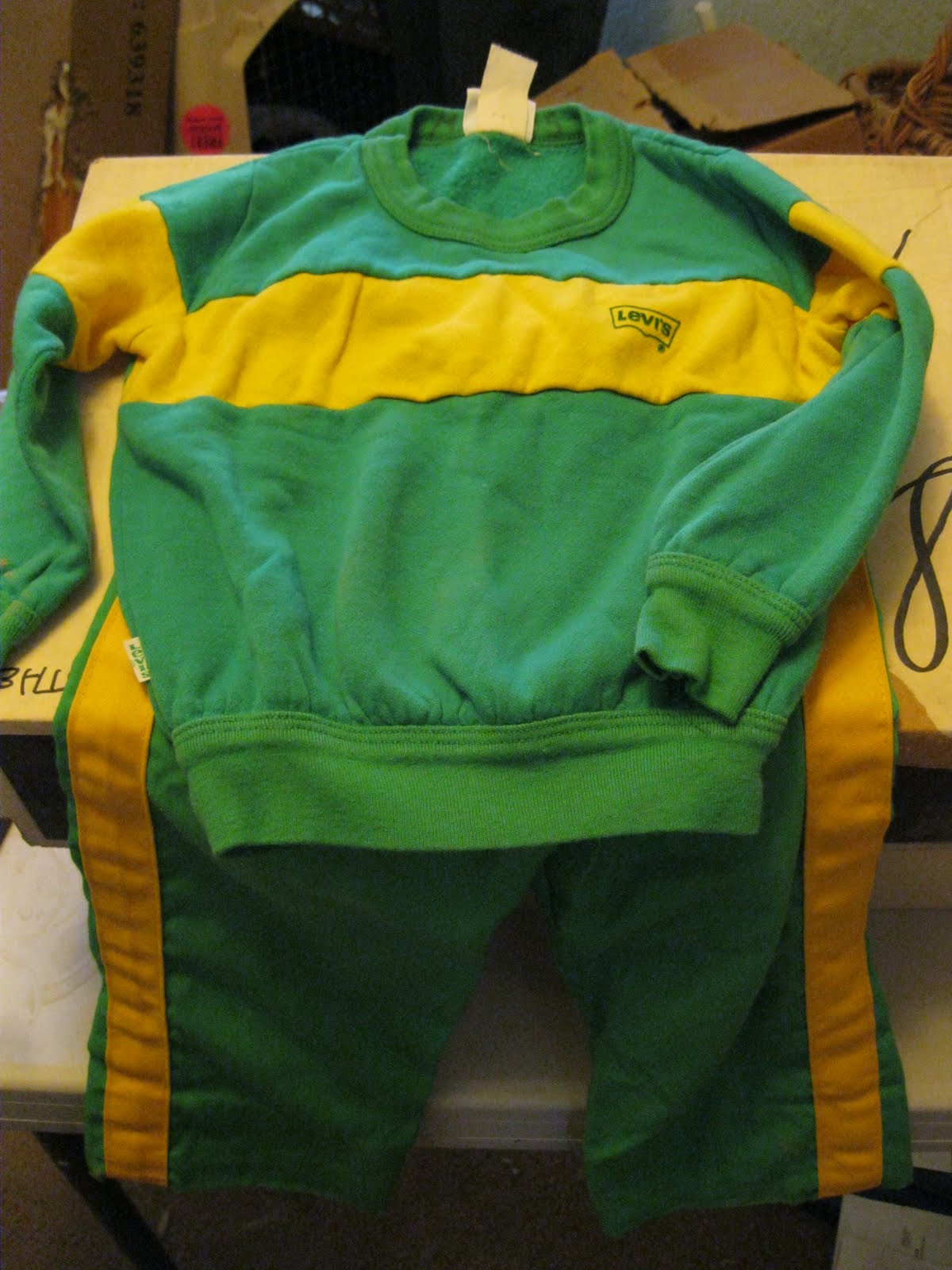
I found the box that contained special items related to my kids. For most of my kids, at least the ones who were adopted at younger ages, I kept the outfits that they wore home the day I brought them home. This is the outfit Marcus wore home at age 3. I remember that his social worker almost cried when she saw him in it, saying with great emotion, "Oh, someone bought him new clothes for this day." His foster mom did not come out to the car to see us off...it was too hard to say goodbye to this special little boy, whom she had started on the road to emotional healing after he was so severely injured by his birthmother.


I made this purse during high school or college. I never took art in high school...didn't want to take the risk of ruining my grade point average. But I hung out in the art room sometimes with a friend of mine. Ms. Dorothy Weatherby, the art teacher, said to me one day, "I know something that I bet you would enjoy..." and she proceeded to show me how to macrame. I later bought some instruction leaflets and made this purse. When I found it in a box this week, I was somewhat amazed that I had made it!


This is our venerable copy of "Little House on the Prairie," which was a gift to my brother from my grandmother during WWII.


This is some of Jesse's art work, probably from kindergarten or first grade. As you can see, his calling as a beautician had early roots.


I was SO happy to find my old monkey, JoJo. I'm not sure who sewed JoJo, but it was my brother's before it was mine, so it was probably made around the time of WWII. So this little monkey is somewhere between 60 and 70 years old.


Now this may be the most inexplicable memento (I told you I was a pack rat). This jar once contained a yellow salve, compounded at Morrison's Drug Store on East Lancaster. It was my mother's cure-all when we were growing up. Scraped a knee? Go get some of that yellow medicine. Burned by steam? Go get some of that yellow medicine. Got a blister on your heel? Go get some of that yellow medicine. I have a feeling that it had sat in our bathroom cabinet so many years, that it had long lost its effectiveness, but we kept using it. Morrison's Drug Store had significance to me for other reasons. The store was robbed one evening and Mr. Morrison was murdered. It was the first time that crime had intruded into my world.


We awaited the arrival of Haley's Comet with great anticipation. I bought Jesse this shirt; the back says, "See you again in 2061." We drove out to Lake Benbrook at 4 AM to try to see it. I was expecting a huge fireball blazing across the sky with a flaming tail. I'm not sure we actually saw it, but we convinced ourselves that we did. We bought donuts on the way home. I had the boys draw pictures of the event and we wrote a story about it, which I also found tonight.


These cute little shoes are Korean slippers that were sent with Leslie when she flew to the US when I adopted her. Evidently they are unisex, because Hollis arrived with a pair, too.


Here are some of my political buttons that I've collected over the years. For several years I thought I might never have a winner among my collection, but there have been several now.


These are baptismal stoles from the baptisms of my first 7 children. The three children who came from Russia had been baptized in the Russian Orthodox church.


I'm sure there are more treasures squirreled away...more boxes await!